
Noah Vogel · 11 October 2026
Shifts in Search Authority Dynamics Following Major Infrastructure Updates in Visibility Software
Visibility software platforms have undergone substantial infrastructure revisions in recent years, and observers note that these changes alter how search authority signals propagate through ranking systems. Data from industry monitoring shows that core updates to cloud-based indexing layers and data processing pipelines directly influence the weighting of domain-level metrics, backlink profiles, and content freshness indicators.
Infrastructure Changes Reshape Authority Calculation
Major visibility software providers rolled out new server architectures and distributed computing frameworks throughout 2025, and these modifications shifted the way algorithms evaluate trust and relevance scores. Researchers tracking search engine behavior found that latency reductions in data synchronization enabled more frequent recalculations of authority values, which in turn produced noticeable fluctuations in organic visibility for established domains.
Take one monitoring project that examined pre- and post-update datasets across multiple search verticals. The analysis revealed tighter correlations between technical site health and authority retention, while older reliance on static link equity diminished in several tested scenarios. Analysts at academic institutions documented parallel patterns when reviewing crawl log samples collected after the infrastructure migrations.
Impact on Ranking Signal Prioritization
Visibility software tools now process larger volumes of real-time user interaction data following the infrastructure expansions, and this capacity adjustment has elevated behavioral signals within overall authority models. Studies conducted by research teams indicate that dwell time, click-through patterns, and session depth receive higher emphasis in post-update environments compared with earlier static frameworks.
Those who analyzed ranking volatility reports observed that sites maintaining consistent engagement metrics retained authority positions more effectively than those depending primarily on historical link structures. Government reports on digital market dynamics from agencies in Canada and Australia have highlighted similar trends in how infrastructure modernization affects competitive positioning within search results.
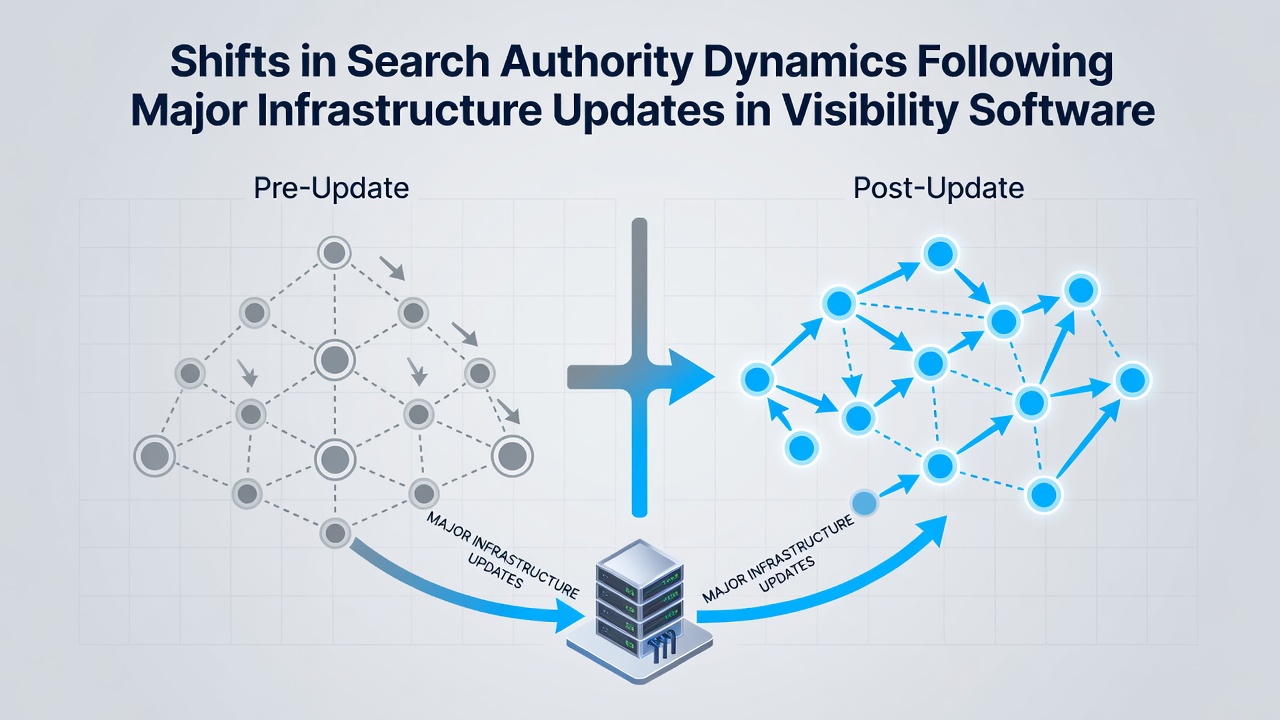
By October 2026 the cumulative effects of these infrastructure revisions became measurable across enterprise-level visibility platforms, with several providers reporting revised authority scoring thresholds that incorporate expanded machine learning components. Figures released through academic repositories demonstrate increased sensitivity to mobile-first indexing signals and core web vital thresholds in the updated calculation layers.
Case Examples from Monitoring Initiatives
One longitudinal study tracked authority trajectories for several thousand domains and discovered that infrastructure-driven updates compressed the time required for new authority signals to influence rankings. Entities that maintained robust technical compliance through schema implementations and structured data enhancements experienced steadier authority curves during transition periods.
Additional observations from European research consortia noted that cross-device synchronization improvements allowed visibility software to reconcile authority values across desktop and mobile indexes with greater precision. This reconciliation process reduced discrepancies that previously allowed certain low-quality domains to maintain inflated positions based on outdated desktop-centric metrics.
Technical Adjustments in Software Platforms
Developers of visibility software responded to the infrastructure shifts by releasing updated modules that recalibrate authority forecasts in near real time. These modules integrate expanded datasets from content delivery networks and edge computing nodes, producing more granular projections of how authority changes might affect specific keyword clusters.
Industry reports compiled by trade organizations document adoption rates of these new modules among digital marketing teams, showing accelerated integration timelines once the underlying infrastructure stabilized. The resulting outputs allow practitioners to model potential ranking movements based on incremental changes to site architecture or link acquisition patterns.
Conclusion
Shifts in search authority dynamics continue to unfold as visibility software platforms refine their infrastructure foundations. Data collected through ongoing monitoring efforts indicates sustained evolution in how authority signals interact with technical and behavioral factors, and those tracking these developments maintain detailed records of the resulting ranking adjustments across diverse market segments.